Client: Bayer GBS
Industry: Life Sciences
Region: Global
From Bottlenecks to Breakthroughs: Discover how Bayer cut manual errors by 70% and sped up procurement processing by over 60%.
Founded in 1863, Bayer is the brand behind world famous inventions such as Aspirin. Now it’s reinventing itself to deliver faster innovation and a better experience for the farmers, patients, and consumers who depend on its work.
To support this aim, Bayer has a Global Business Services (GBS) division. It uses new ideas and cutting-edge technology to optimize processes and improve business performance in areas like finance, human resources, IT, and procurement.
Meritxell Corbeto González is RPA Project Manager – GBS Intelligent Automation. She’s based in the Barcelona GBS office, one of many around the world. “Our focus is on efficiency, innovation, scalability and quality,” she says. Her role is all about making the business work better so it can reach its strategic goals. And automation is at the heart of what she does.
Addressing a pain point
One of the most successful projects she’s delivered is the intelligent automation of purchase requisitions and purchase orders globally. This used to be a largely manual, inefficient task, which was susceptible to errors. While the process used some automation, it was limited.
“Every automation starts with a need or a problem,” Corbeto explains. “There was certainly pain in this process. It’s a similar situation in many organizations. People enter data by hand, which takes a long time and can cause mistakes. There are verification and conversion tasks, leading to bottlenecks, delays in procurement cycles, and increased operational costs.”
Corbeto adds: “We are committed to continuously improving our processes so we can meet customer needs with greater efficiency and agility.”
Before the bots
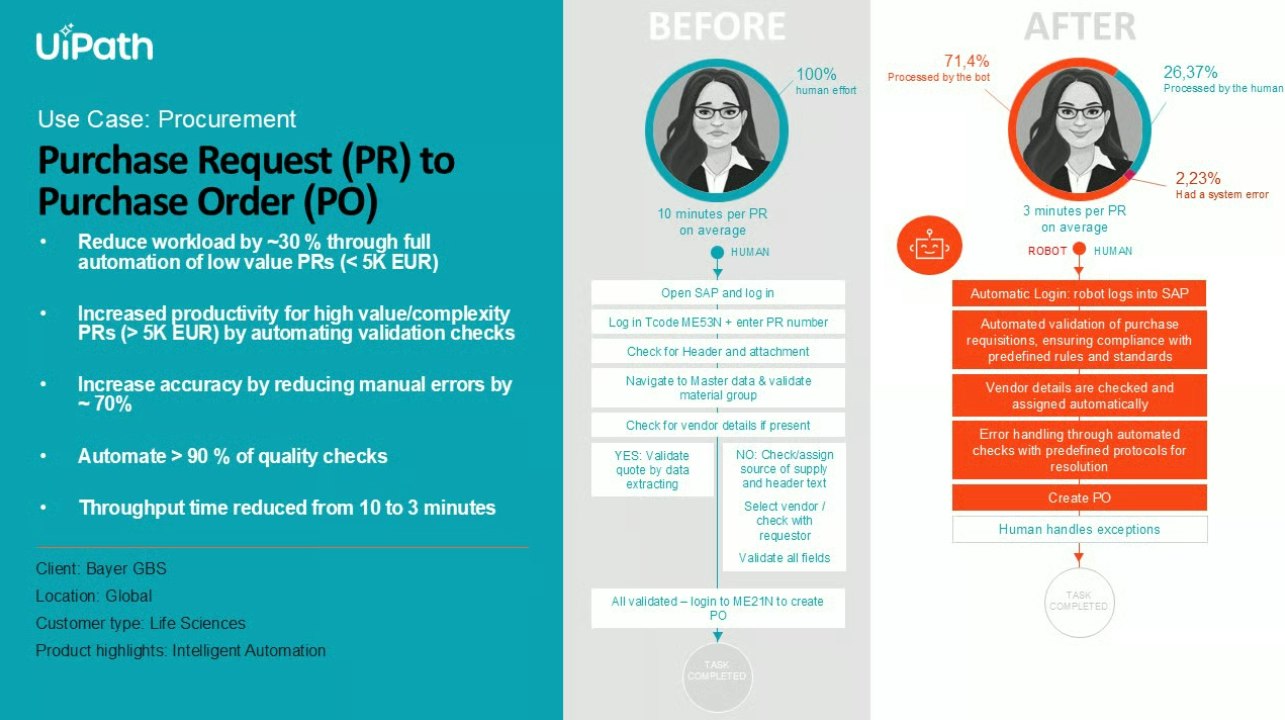
Prior to intelligent automation, the process involved several manual steps. Employees logged into the SAP system, validated purchase requests, and manually checked vendor details and material codes. This meant going through multiple systems to make sure the information was correct. Vendor details often needed to be confirmed by hand, which meant talking to the person raising the request.
Data further underlined the need for improvement. About 30 percent of all purchase requests were not automated, and 36 percent of these were under 5.000€. This meant there was a lot of time wasted, sometimes by senior employees, handling small amounts.
By using smart automation, Corbeto and her team wanted to reduce work by 30 percent, increase productivity, and produce significant savings to the countries. With 900 purchase requests made on peak periods such as January and November, it is easy to see how these savings would be made.
“Automation promised to free valuable human resources, allowing employees to focus on more strategic tasks that contribute to business growth,” adds Corbeto. It would also enhance compliance with procurement policies. This is vital for a publicly traded company like Bayer, which operates in a highly regulated sector. It would also help the company embrace digital transformation and remain competitive in a constantly changing business environment.
A transformation
With the new intelligent automation solution, a robot logs into the SAP system automatically. It checks if a purchase request is valid, making sure it follows the rules and standards set by the company. Then it checks and assigns vendor details, reducing the need for manual verification.
Finally, the purchase order is created automatically. The robot fetches details from the purchase request, using predefined rules to maintain compliance and accuracy. There are also automated checks in place to oversee exceptions, such as missing vendor details or incorrect pricing. These can be resolved using GenAI.
The results have been outstanding. Manual errors are down by about 70 percent. There were also 60 percent fewer mistakes about vendor and pricing details. Meanwhile, the time taken to process a purchase request and deliver a purchase order dropped from 10 minutes to just three, significantly speeding up operations and allowing for faster transaction processing. “In the future, we want to get the time per request down to one minute,” Corbeto explains.
Thinking about how this supported the business more widely, Corbeto adds, “The automation improved operational efficiency, reduced costs associated with manual processing, and enhanced the company’s ability to handle a higher volume of transactions without compromising on quality.”
“From a team perspective, it boosted morale and reduced stress. And for customers, they got better service delivery, which enhanced customer satisfaction, reinforcing Bayer’s reputation.”
Download the full case study below:
Procure_to_pay_agentic_customer_stories_ebook__1_.pdfThis article is sponsored by:

Originally posted on 2025-04-03 in the IRPA AI Network — Enterprise AI