Author: IRPA AI Senior Analyst & Former White House Digital Transformation Advisor, Chris Surdak
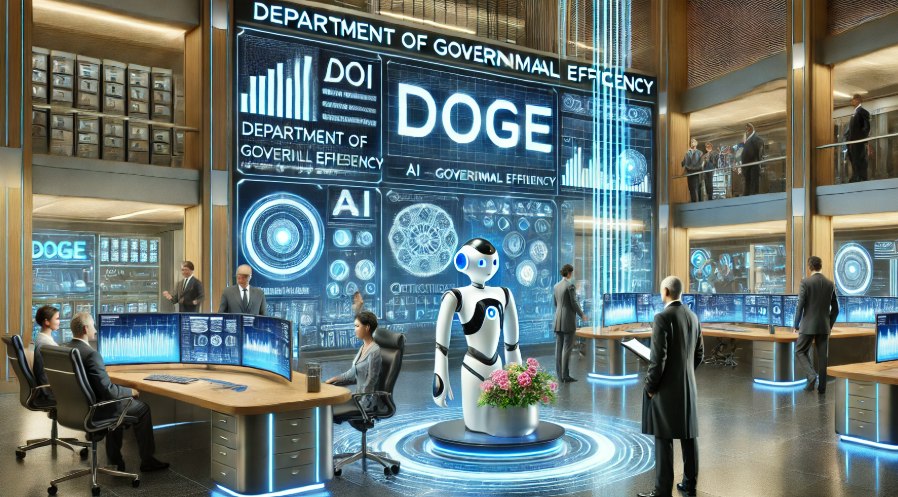
For anyone paying any attention lately, President Trump’s Department of Government Efficiency (DOGE), led by Elon Musk, is certainly generating a lot of news. Whether you love or hate this DOGE duo, one has to admit that they are generating significant, disruptive change.
That is the nature of real transformation; if it doesn’t hurt, it’s probably not transformational.
Reports are that DOGE is staffed by a large team of young technocrats, highly skilled in getting into the guts of computer systems and data stores, many of which are significantly older than these operators. Businesses that struggle with technical debt can only marvel at billions of paper records being stored in an old mine in Western Pennsylvania.
In their most recent stir-up, Elon asked that all federal employees email him with a list of five things that they did last week. This seemingly-innocuous request lit a firestorm across social media and legacy media, apparently representing a deeply-troubling invasion of privacy and national security.
Now, I don’t know about you, but in my career in the private sector, such a reporting of activity and (hopefully) progress was as normal as showing up for work each day. And this, apparently, is part of the problem that Elon was addressing. According to DOGE’s research, thousands if not tens of thousands of federal “workers” may not be working at all. Indeed, they seem to have data that suggests that many of these workers are either deceased or never existed.
Do You Grok?
Having worked in eDiscovery and behavioral analytics for a very long time, I suspect that there is a deeper goal from this exercise. Yes, non-responsive “employees” may prove to be hoaxes, long collecting a federal paycheck. But the other goal here may be to start mapping out friends and foes, and networks of relationships throughout the federal bureaucracy. AI technologies have advanced powerfully in this arena, and analyzing the message traffic that this request lit off may provide DOGE’s analysts with a great deal of data for further digging.
Elon’s Grok AI could easily digest nearly all of the data held on government computers. I cannot confirm, but do suspect that this is what has been done, and that the extreme examples of waste and potential fraud in government expenditures have come from this effort. One could imagine prompting a government-data-trained AI, “Find me the most egregious and headline-grabbing case of wasteful spending in department X,” and Grok would readily comply.
Directed at government email servers, the same AI could be asked, “After the email demanding 5 things they did last week, which employees sent a panicky email to their supervisor or colleagues?”, and again, Grok would happily and rapidly comply. Such analyses were fairly common in eDiscovery a decade ago, leading me to believe that this is amongst the goals of the recent demand for Proof-Of-Life communications.
Optimization or Oppression?
Is such automated oversight of a human workforce necessary? Perhaps. Is it ethical? Again, perhaps. Workers have always operated under the expectation of oversight and critique in the quid pro quo of employment. What may be ethically-challenging is such oversight coming at the absence of context. One might have a job where they have one and only one function to perform, and they must do it consistently and conscientiously. Such a person might, upon receipt of Elon’s email, themselves send a panicked message to their supervisor asking how they should respond. Perhaps the singular focus of their job would survive scrutiny; but perhaps not.
We are witnessing the unfolding of a new era of work and labor in society. We have been here before, but never with this speed, scale and scope. The steam engine unlocked the industrial revolution, and displaced or redistributed vast swaths of the workforce. Creation of the oil economy further accelerated global economic growth, while making all of humanity dependent upon this limited resource and putting our environment at risk.
Computers and the Internet enabled the Information Age and the expansive wealth and prosperity that billions of us depend upon, while at the same time making billions of us at risk of losing our jobs at the hands of better, faster and cheaper information workers known as AI. Technology always causes both positive and negative social impacts. Over time, both of these have accelerated to the point that the disruption caused by AI may be very difficult for most of us to fully absorb.
This change is not coming, it is upon us. Transformation is here, and it’s probably going to hurt. Some of us will certainly benefit from the changes brought by AI; perhaps most of us will. But being Grokked along the way is going to force many of us to rethink our definitions of “work,” “productivity” and “humanity.”
About the Author: Chris Surdak

Chris Surdak is a Senior IRPA AI Advisor and was formerly White House Chief Transformation officer, Automation & AI Practice Lead at EY & Executive Partner for Digital Transformation at Gartner. He’s an engineer, futurist, transformation executive and best-selling author, with over 30 years’ experience in technology development and deployment, digital transformation, blockchain, data and analytics and AI & intelligent automation
CLICK HERE TO SCHEDULE AN ANALYST CHAT
Links:
Originally posted on 2025-03-14 in the IRPA AI Network — Enterprise AI