
Author: IRPA AI Senior Analyst, Kieran Gilmurray
Picture this: you’ve just wrapped a brainstorming session, full of big ideas and bold goals. But minutes later, you’re slammed with updates, urgent emails, and a mess of tasks that drag your focus away from strategy. Welcome to modern work: fast-paced, reactive, and mentally exhausting.
Agentic AI promises a better way. Unlike traditional automation that sticks to scripts, agentic AI evolves from simple assistants into intelligent partners that adapt, make decisions, and anticipate needs. It’s a shift from “do this” to “figure out what needs doing.”
This transformation is structured into five levels. Let’s explore how agentic AI progresses from task-taker to autonomous problem-solver, and how you can prepare for this future.
What is Agentic AI?
Agentic AI systems are more than tools; they’re goal-oriented agents capable of planning, adjusting, and acting without constant human instruction. Think of a system that doesn’t just respond but collaborates. It learns what matters to you and refines its own behaviour based on outcomes.
The Five Levels of Agentic Automation
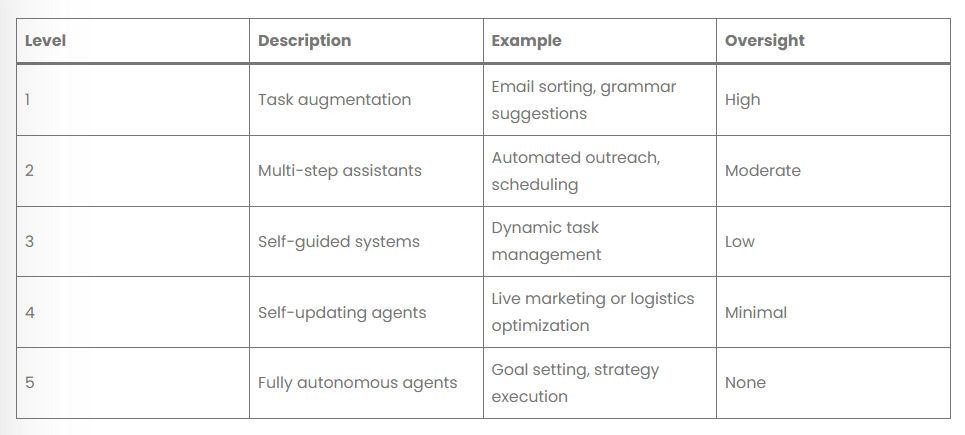
Level 1: Simple AI Augmentation
At this foundational level, AI functions as a digital helper that automates single, routine tasks. Think spell-checkers, email classifiers, or tools that flag emotional tones in customer messages. These systems use rules and patterns to make quick, low-risk decisions.
What It Does:
Level 1 AI reduces the mental overhead of repetitive chores. It helps prioritise emails, suggests clearer phrasing, or surfaces key data. It’s reactive: waiting for inputs and acting accordingly, but it doesn’t adapt to surprises or change tactics mid-stream.
Why It Matters:
This level is the training wheels of agentic AI. It helps users build trust in AI without needing deep technical skills or complex oversight mechanisms.
Real-World Example
Slack’s AI-powered message prioritisation filters essential updates in cluttered threads, allowing users to focus without missing what matters.
Level 2: Task-Specific Multi-Step Agentic Assistants
This level marks a step into intelligent workflows. AI now handles multiple actions in sequence, across platforms, and sometimes even initiates them. For example, it might write a follow-up email, schedule a meeting based on your calendar, and trigger reminders, all from a single instruction.
What It Does:
Unlike Level 1, which only reacts, Level 2 connects dots. These assistants access multiple tools and datasets, making decisions within clearly defined limits. They’re useful for roles such as HR, sales, and marketing, where predictable processes are prevalent.
Why It Matters:
These agents save hours each week by removing the need to manually push every button. While they don’t adapt on the fly, they offer a solid return on investment and increase team productivity with little training.
Real-World Example
Calendly’s AI Scheduling Assistant handles full coordination of meetings, detecting ideal times based on habits, preferences, and availability.
Level 3: Self-Guide Execution & Reflection
Now we’re entering the domain of strategic assistance. Level 3 AI reflects on outcomes, self-corrects, and adjusts its methods, essentially learning how to work better with every cycle. This is where AI begins to act like a junior project manager.
What It Does:
Level 3 systems incorporate feedback loops. They review progress, assess whether the results align with the goals, and make course corrections as necessary. If a deadline seems unachievable, the AI might revise the timeline or reassign resources.
Why It Matters:
This is where real partnership begins. You’re no longer programming the AI; you’re aligning with it. It identifies problems before you do, makes informed suggestions, and often resolves issues independently.
Real-World Example
Asana’s Smart Workload Manager redistributes tasks when it detects bottlenecks, ensuring a smooth project flow without requiring human intervention.
Level 4: Aadaptive, Self-Updating Agents
Level 4 AI doesn’t just tweak tactics, it rewrites the playbook. These agents learn continuously from data streams and autonomously update their strategies. If a new trend emerges or an obstacle appears, they shift direction without needing to be told.
What It Does:
They optimise in real time. Whether reallocating marketing budgets mid-campaign, rerouting logistics due to supply disruptions, or tailoring product recommendations during a live sale, these agents adapt instantly.
Why It Matters:
This is agility at machine speed. Organisations using Level 4 AI respond faster to market shifts, scale operations more intelligently, and maintain competitive advantages, without burning out staff.
Real-World Example:
Meta’s Advantage+ Campaigns use real-time audience data to adjust advertising strategies automatically, refining messaging, targeting, and spend in seconds.
Level 5: Fully Autonomous Digital Workers
This is the speculative future: AI that doesn’t just support strategy but creates it. These systems identify opportunities, define goals, make decisions, and execute across domains, all without human input. They’re not assistants, they’re autonomous agents with agency.
What It Does:
At this level, AI might analyse market conditions, propose a new product line, budget the campaign, hire talent, and negotiate vendor contracts, all without a human ever being asked to step in.
Why It Matters:
If realised, Level 5 could revolutionise entire industries. But it also raises critical concerns around bias, accountability, and governance. Who is responsible when a fully autonomous agent makes a mistake? How do we build trust when humans are no longer in the loop?
Speculative Example:
IBM Watsonx is moving toward this vision, integrating reasoning, decision-making, and adaptive learning for enterprise-scale tasks.
Preparing for the Journey
No matter your size or industry, embracing agentic AI starts with readiness:
- Data Infrastructure: Quality, centralised, accessible data is your foundation.
- Clear Boundaries: Define what AI can do alone vs. what requires oversight.
- Organisational Culture: Embrace experimentation and continuous learning.
- Ethical Governance: Embed fairness, explainability, and accountability into every AI deployment.
Conclusion: From Task Execution to Strategic Partnership
Agentic AI isn’t just about working faster; it’s about working smarter. It’s the evolution from tools that take commands to agents that co-create solutions. Whether you’re just exploring Level 1 or piloting adaptive workflows at Level 4, each step unlocks new productivity and strategic value.
The future of work is not human vs. machine; it’s human with machine. The real opportunity lies in using agentic AI to elevate what we do best: think creatively, lead ethically, and solve problems with purpose.
About the Author: Kieran Gilmurray

Senior IRPA AI Analyst & Advisor, Kieran Gilmurray is a certified executive coach, intelligent automation & digital transformation thought leader & content guru focused on helping solve complicated problems others can't. For the past 25+ years, he has driven business digital transformation programs across a range of industries like digital technologies, intelligent automation, data analytics, social media and robotic process automation, having generated millions of dollars of value.
CLICK HERE TO SCHEDULE AN ANALYST BRIEFING
Links:
Originally posted in the IRPA AI Network — Announcements & Updates