Author: IRPA AI Senior Analyst, Kieran Gilmurray
Small Language Models: The Future of Efficient AI
Large Language Models (LLMs), such as Open AI’s GPT-4 have garnered significant attention for their ability to handle a wide range of tasks, but they come with hefty computational requirements. In contrast, Small Language Models (SLMs) are compact AI models designed for efficiency and specialization. SLMs can deliver high-quality language understanding and generation with a fraction of the resources that LLMs require. In fact, some SLMs are up to 88× smaller than ChatGPT yet still rank among the top performers on key benchmarks. For CTOs and business leaders, SLMs open a whole host of strategic possibilities: enabling AI-driven solutions that are faster, more cost-effective, and easier to deploy. This article briefly compares SLMs vs. LLMs and then explores how SLMs are delivering proven benefits across industries like law, healthcare, business automation, and edge computing.
SLMs vs. LLMs: A Strategic Overview
While both types of models interpret and generate human-like text, there are important differences in their scope and operational footprint:
- Scope and Use Cases:SLMs excel at domain-specific tasks and operate on focused datasets (e.g. analyzing customer feedback or handling industry-specific jargon), often deployed at the edge or on-premises for specialized applications. LLMs, on the other hand, are general-purpose systems trained on vast, diverse data (billions of words) to handle a broad range of queries and complex reasoning. An LLM like GPT-4 can answer questions on almost any topic, whereas an SLM might only answer within a defined domain but with greater depth in that area.
- Size and Infrastructure:SLMs usually contain far fewer parameters (often under 100 million) and thus require less memory and compute power. They can run on standard servers or even mobile devices, allowing on-site deployment. LLMs have billions (even trillions) of parameters, demanding powerful GPUs or cloud clusters to run. This means LLMs often rely on cloud services, whereas SLMs can be run locally on an organization’s own hardware, or even on smartphones and IoT devices in some cases.
- Performance and Speed: Because of their smaller size, SLMs offer faster inference and lower latency. They can provide real-time responses crucial for interactive applications (like customer service chatbots or writing assistants) without the lag that sometimes comes with large models. LLMs might achieve more sophisticated understanding on extremely complex tasks, but they can be slower and overkill for routine needs. In practice, an SLM can be a “master of one trade,” delivering quick, relevant answers in its niche, whereas an LLM is a “jack-of-all-trades” that might be slower or less tuned for any single domain.
- Privacy and Compliance:SLMs can be deployed on-premises or at the network edge, ensuring that sensitive data (legal documents, patient records, proprietary business data) stays in-house rather than being sent to external servers. This local deployment greatly reduces privacy risks and eases compliance with data protection regulations. LLMs often run via cloud APIs, which could expose confidential data or raise concerns about data governance. For industries with strict privacy requirements, the ability to control where and how data is processed gives SLMs a significant advantage.
In summary, LLMs provide broad capabilities and raw power, but SLMs offer focus, speed, and efficiency. Organizations don’t always need one gigantic model to “rule them all” – often a collection of smaller, task-tuned models can yield better results with lower cost.
Key Benefits of Small Language Models
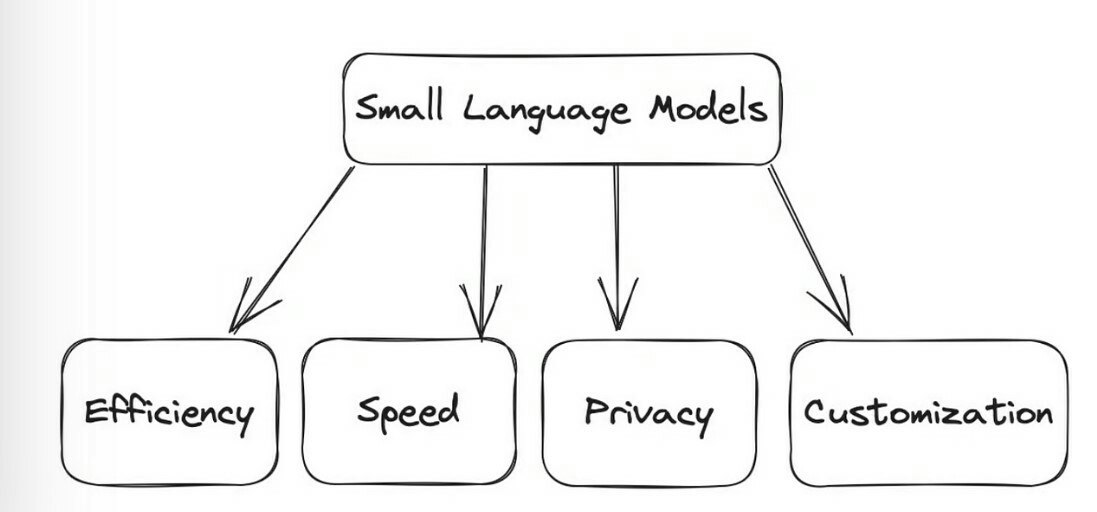
SLMs bring several strategic benefits to businesses and CTOs looking to implement AI solutions efficiently:
- Faster Response Times: With their lightweight architecture, SLMs can be trained quickly and deliver responses in milliseconds. This low latency is ideal for real-time applications like interactive chatbots, virtual assistants, or live analytics dashboards. Users get instant feedback, improving experience and productivity.
- Cost Efficiency and Lower Energy Use: Smaller models mean less computational overhead. SLMs require less processing power and memory, which cuts down cloud usage and hardware costs. They also consume less energy, making them more environmentally friendly and cheaper to run at scale. For a business, this can translate into significant savings, especially when deploying AI across thousands of devices or interactions.
- Data Privacy and Control: Because SLMs can run on local servers or devices, companies retain full control of their data. Sensitive information (financial records, personal health data, legal documents) can be processed on-site without sending it to third-party cloud services. This on-premise capability not only mitigates data leakage risks but also simplifies compliance with regulations in healthcare, finance, and law. In short, SLMs allow AI integration without sacrificing privacy.
- Explainability: As models become smaller and more manageable, understanding how they make decisions becomes more accessible, which is crucial for trust and transparency in AI applications.
- Domain-Specific Accuracy: SLMs can be fine-tuned to specialized datasets, making them highly accurate for niche tasks. By focusing on industry-specific vocabulary and context, SLMs often avoid the irrelevant or incorrect outputs (“hallucinations”) that broad LLMs might produce when faced with specialized queries. For example, a small language model trained exclusively on medical texts or legal contracts is more likely to produce more precise results in those context than a generic large model. This precision reduces errors and builds trust in AI outputs.
- Edge Deployment and Offline Capability: Thanks to their small footprint, SLMs shine in edge computing scenarios. They can run on smartphones, IoT sensors, or embedded systems that have limited compute resources. This enables AI-powered features without internet access or high-powered servers – think of language translation or speech recognition in a mobile app working even in airplane mode. In industrial settings, SLMs on factory equipment or remote oil rigs can analyse data on-site, providing immediate insights despite spotty connectivity. Such offline capabilities are crucial for use cases in remote locations, disaster response, and any situation where real-time local decision-making is needed.
These benefits make SLMs a compelling choice for organizations that need efficient and scalable AI. Now, let’s look at how SLMs are being applied in specific industries to drive value.
SLMs in the Legal Industry (Law)
In the legal field, accuracy and confidentiality are paramount. Large general models have demonstrated they can draft text, but they sometimes “hallucinate” i.e., generating incorrect information – which is unacceptable in law where even a minor error can be a serious liability. Small language models offer a solution by being specialized legal experts. Trained on legal datasets (case law, statutes, contracts), an SLM can parse complex legal language and provide outputs with a high degree of reliability and relevance.
For example, an SLM tailored for legal use can analyze contracts, extract legal terms, and streamline document review for lawyers. Rather than relying on a massive model that knows a bit about everything, law firms use SLMs that know a lot about legal specifics – from terminology to typical clause structures. This specialization means the AI is less likely to go off-topic or produce wrong answers. One real-world example is Personal AI’s legal model, a small-scale AI assistant designed for law firms. It focuses on each firm’s proprietary data and “learns” the style and context of that firm’s cases to deliver precise recommendations and document drafting support. Such tools can automate routine tasks like contract analysis or case brief summarization, saving attorneys valuable time while ensuring the outputs align with legal standards and precedents.
Another key benefit of SLMs in law is data security. Legal documents are sensitive and sending them to a third-party cloud service for analysis is often out of the question. SLMs can be deployed on a law firm’s own servers (or even on a lawyer’s laptop), keeping client information strictly confidential. This empowers legal professionals to leverage AI for research and drafting without breaching ethical or regulatory obligations. In short, SLMs allow the legal industry to embrace AI-driven efficiency (e.g., faster document review, intelligent drafting assistants) without compromising on accuracy or privacy – truly a strategic win for forward-looking law firms.
SLMs in Healthcare
Healthcare is another domain where smaller AI models are making a big impact. Hospitals and clinics deal with highly personal data and life-critical decisions, so the ability to have AI support on-premises and in real-time is game-changing. SLMs, with their efficiency and focus, fit naturally into healthcare workflows.
One powerful application is in clinical documentation and decision support. For instance, a hospital could leverage an SLM to automatically generate an accurate patient summary for doctors. The data informing diagnosis, and treatments, largely consists of words, often incrementally accrued. This leads to many opportunities for gaps in narrative leading to misinterpretation. By using digital technologies to provide more objective and continuous data collection and using that data to train a model on the hospital’s own continually updated electronic health record (EHR) data, an SLM can take a patient’s history and latest vital signs as input and produce a concise overview or even preliminary diagnostic recommendations for the physician. That can be augmented with data from smartphones and wearable devices, geolocation data. All this can happen instantly, before the doctor even steps into the exam room, and the summary can be saved back into the patient’s record. Doctors thus get a quick, up to date, AI-curated briefing, potentially highlighting important family history, mental health issues or lab results that need attention.
Because the model is small and focused only on medical data, its recommendations are context-aware and easier to trust. Equally important, all of this processing happens locally within the hospital’s IT environment – no patient data leaves the premises. This addresses the huge concern of patient privacy (think HIPAA compliance): the SLM can assist with care without sending sensitive health information to a cloud server.
Beyond document summarization, healthcare SLMs can power virtual health assistants. Imagine a clinic deploying a chatbot (powered by a medical SLM) on their website or patient app. This bot could answer common patient questions, help schedule appointments, or remind patients about medication refills. Because it’s a small model fine-tuned on that clinic’s specific services and guidelines, it provides relevant and safe responses. It can even operate 24/7 and offline if needed, which is useful for remote telehealth devices. Early examples are emerging where wearables and smart health devices include SLMs to monitor metrics like heart rate or blood sugar and give immediate, spoken feedback to users – all without needing internet connectivity.
Overburdened doctors often get little time with patients leading to missed opportunities to aid their patient. AI systems can also analyse vast troves of transcripts to help doctors better navigate and understand what types of interventions maybe needed in different context and point to potential treatment plans having gained insights they might otherwise have missed.
In summary, SLMs in healthcare drive efficiency (e.g. reducing doctors’ paperwork), enhance patient engagement via chatbots, and maintain strict privacy. They allow healthcare providers to automate and augment their services in a controlled, cost-effective way. As a result, overworked medical staff get decision support, and patients receive timelier information resulting in a healthy outcome for all.
SLMs in Business Automation
Across industries, businesses are harnessing SLMs to streamline operations and automate tasks – often under the umbrella of business process automation and enterprise AI. Unlike one-size-fits-all large models, small models can be deployed department-wise or task-wise, optimizing specific workflows with precision. This targeted approach is particularly appealing to CTOs concerned about cost, data security, and ease of integration with existing systems.
Customer service is a prime area where SLMs can shine. Companies can train small language models on their proprietary customer support logs and FAQs to create intelligent chatbots. These bots handle routine inquiries (password resets, order status, basic product info) swiftly and accurately, freeing human agents to tackle more complex issues. Because the SLM knows only the company’s domain, it stays on-topic and provides answers that are consistent with the company’s policies and knowledge base. For example, a bank might use an SLM for its online help desk that can explain banking products and check account details securely. The model can run within the bank’s firewall, ensuring no customer data ever goes to an outside cloud. This reduces compliance risks in financial services where data governance is strict.
Another area is internal business analytics and document processing. Organizations generate tons of text – emails, reports, contracts, meeting notes – and small models can help digest this information. An SLM could be fine-tuned to analyze weekly sales reports and automatically highlight key trends for managers. Or it might take an incoming email and suggest an appropriate response draft to an employee, based on past similar communications. Some companies have even built SLM-powered systems to read incoming resumes and filter candidates, or to scan legal documents for specific clauses as part of risk management. These targeted automations accelerate workflows significantly.
Robotic Process Automation (RPA) tools are also starting to incorporate SLMs for handling unstructured text. For instance, an insurance company could deploy a small language model to read claim descriptions and extract key details (names, dates, damage descriptions) to feed into their processing system using automation. Since the model is trained on the company’s historical claims data, it understands the jargon and formats used by that business. This reduces errors and manual data entry.
Crucially, all these use cases benefit from the lower cost of running SLMs. Instead of paying for expensive API calls to an external LLM service, businesses can run many small models on their existing hardware. This scalability means a company could have dozens of mini-AI assistants across departments for the same cost as using one large model in the cloud. The result is an organization that’s gradually infusing AI into every workflow, from HR to marketing to operations, in a sustainable, governed manner. Businesses adopting SLMs report improved efficiency and employee productivity, as repetitive tasks are automated, and decision-making is augmented with AI insights.
SLMs at the Edge (Edge AI)
One of the most exciting frontiers for SLMs is edge AI – bringing intelligence to devices and locations outside the traditional data centre. Edge environments include everything from smartphones and laptops to IoT sensors in a factory or agricultural field. The constraints at the edge are usually limited computing power, limited internet connectivity, or both. SLMs, being lightweight, are perfectly suited to overcome these constraints and enable smart functionality on the edge.
A clear example is in consumer electronics: modern smartphones use small language models for features like predictive text, autocorrect, or voice dictation. When your phone suggests the next word in a text message or understands a voice command without sending it to the cloud, that’s an SLM at work. By running these models on-device, companies like Google and Apple enhance user privacy (since your keyboard presses or voice recording aren’t uploaded) and provide instantaneous response (no network latency). Similarly, smart home devices such as thermostats or security cameras are beginning to integrate SLMs. An SLM in a smart thermostat can learn your preferences and adjust temperatures by analyzing household patterns – all done locally. Even if the internet is down, the thermostat remains “smart.”
In industrial and remote settings, edge-deployed SLMs are proving invaluable. Consider agriculture: sensors in a field can include a small language model that analyzes soil reports or weather data on the spot, then advises a farmer on irrigation or fertilization with no cloud connection needed. Or consider a factory floor: an SLM can be embedded in a machine to monitor performance logs and flag anomalies in real-time, helping prevent breakdowns. Because it operates on the edge, this kind of monitoring continues even in environments with patchy connectivity (like an offshore oil platform or an underground mining site). It provides immediate, on-site insights rather than relying on sending data to a distant server and waiting for a response.
Edge AI SLMs also play a role in emergency and field operations. During disaster response, for example, power and internet may be knocked out. Teams in the field could use portable devices running SLMs for language translation to communicate with local populations or to analyse incoming reports. ISG research notes that emergency responders can deploy SLM-powered tools during disaster relief to translate languages or perform on-the-spot data analysis without needing any cloud services. This robustness can save lives when infrastructure is compromised.
Ultimately, SLMs at the edge extend the reach of AI. They allow intelligence to live directly where action is needed – whether it’s in a clinic, a courtroom, a customer’s phone, or a cornfield – rather than being confined to big data centres. This trend also reduces reliance on constant connectivity and massive centralized systems, aligning with a more distributed, resilient approach to AI deployment.
Notable Smaller Language Models
- Hugging Face’s DistilBERT: A distilled version of the robust BERT model, DistilBERT retains 97% of its predecessor’s language understanding capabilities while being 40% smaller and 60% faster.
- Google’s EfficientNets: Initially designed for computer vision tasks, the principles behind EfficientNets have inspired the development of similarly efficient NLP models.
- EleutherAI’s GPT-Neo and GPT-J: As open-source alternatives to the GPT models, GPT-Neo and GPT-J have offered varying sizes, including smaller versions.
- Microsoft’s Phi-2: Announced in 2023, Phi-2 is a 2.7 billion-parameter model that showcases exceptional reasoning and language understanding.
- LLaMA by Facebook/Meta AI: The LLaMA models, available in various sizes, underscore the trend towards efficiency without sacrificing output quality.
Conclusion
Small Language Models are poised to shape the future of efficient AI. For business decision-makers, they offer a pragmatic approach to leveraging AI: delivering targeted performance improvements without the heavy investment and risk that come with giant models. From the examples in law, healthcare, enterprise automation, and edge devices, we see a common theme – SLMs make AI more accessible, affordable, accurate, and practical across a wide range of use cases. They enable companies to embed intelligence wherever it’s needed, be it a legal research tool that never leaves the firm’s network or a mobile app that provides AI features offline.
It’s important to note that SLMs are not necessarily a drop-in replacement for all large-model capabilities. Instead, they complement the AI ecosystem. Organizations may still use LLMs for broad, complex tasks, but SLMs can handle the specialized jobs with greater efficiency. Many forward-looking businesses are adopting a hybrid strategy: integrating SLMs into their workflows for routine and domain-specific tasks, and reserving LLM usage for the few cases that truly need that extra horsepower.
As hardware continues to advance and research in model optimization progresses, SLMs are expected to become even more powerful. We can anticipate small models tackling increasingly complex functions without ballooning in size. This means the gap between what’s possible with an SLM versus an LLM will narrow over time, further reinforcing the appeal of smaller models. In the coming years, AI development will likely focus on this balance of right-sizing models to tasks, aligning with business goals of agility and cost-effectiveness.
In conclusion, small language models represent a strategic opportunity: they are the future of efficient AI, enabling innovation that is tightly aligned with business needs. By embracing SLMs, companies can unlock AI-driven growth and automation in a controlled, sustainable way whilst achieving big outcomes with small models.
About the Author: Kieran Gilmurray

Senior IRPA AI Analyst & Advisor, Kieran Gilmurray is a certified executive coach, intelligent automation & digital transformation thought leader & content guru focused on helping solve complicated problems others can't. For the past 25+ years, he has driven business digital transformation programs across a range of industries like digital technologies, intelligent automation, data analytics, social media and robotic process automation, having generated millions of dollars of value.
To schedule an analyst briefing CLICK HERE
Links:
Originally posted in the IRPA AI Network — Enterprise AI