In the realm of IT service management, metrics like call duration and resolution time have become commonplace. But there is one metric that surpasses them all - cost per ticket. Unfortunately, many service desks are unaware of their cost per ticket, even though the cost per unit is a widely used metric in every economy. This article will explore the significance of this metric and how understanding it can lead to increased service desk efficiency and higher customer satisfaction.
What is the cost per ticket?
Cost per ticket is a simple calculation that involves dividing the total monthly operating expenses of your service desk by the number of tickets you received in that month. In customer service, there are two essential metrics: customer satisfaction and cost per ticket. While customer satisfaction may be subjective, cost per ticket is objective and straightforward. All other metrics generally revolve around service quality relative to cost containment.
Cost-per-ticket analysis can reveal various scenarios.
- high customer satisfaction but a higher-than-expected cost per ticket.
- high cost per ticket but low customer satisfaction.
Examining both cost per ticket and customer satisfaction highlights the necessary balance between the two.
Determining your service desk's operating expenses may be challenging, especially if you have not been keeping clear records. Since IT support is labor-intensive, with enough staff needed to field service requests, you will probably incur significant costs in service desk personnel. Your company may spend up to 60-70% of its costs on direct and indirect service desk employees.
What drives the cost-of-service desk tickets?
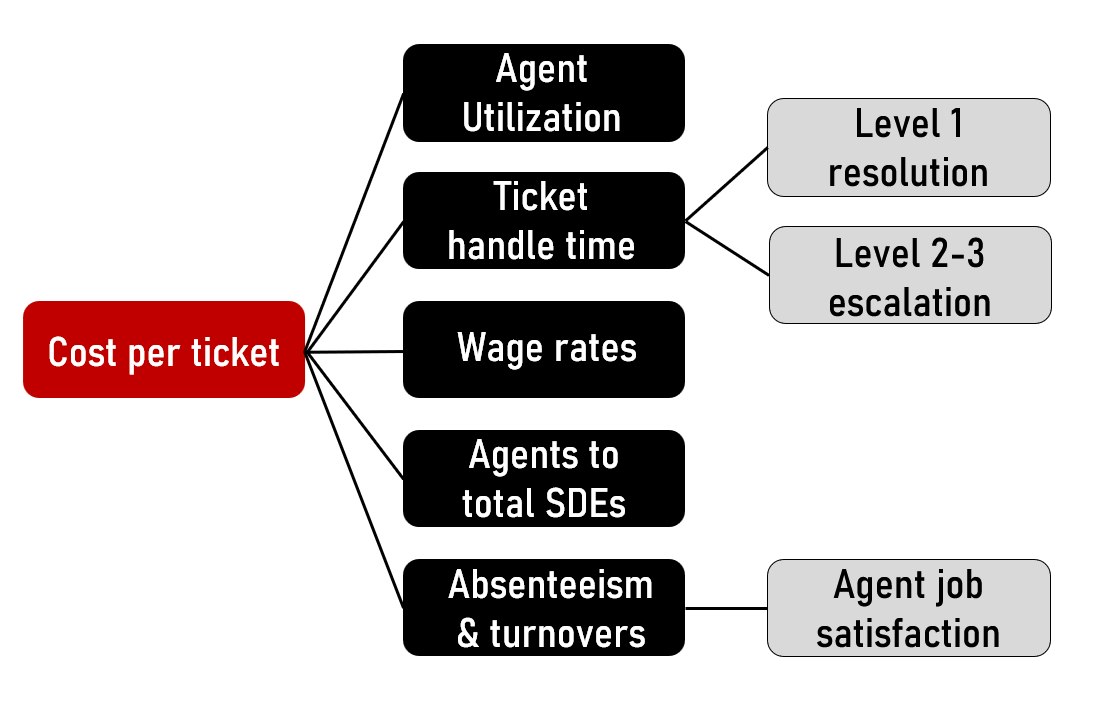
The cost per ticket is influenced by several drivers, including agent utilization, ticket handle time, wage rates, the ratio of agents to total service desk employees, and turnover and absenteeism. As service desks adopt more self-service and chatbot tools for common issues, the cost per ticket will change.
Understanding the cost-per-ticket metric is crucial for any IT service and support manager. It is an objective and straightforward way to measure the balance between service quality and cost containment. With a deep understanding of this metric, service desks can gain insights into their operating expenses and devise automation strategies to optimize performance in this critical business area.
Intelligent automation is the key to reducing service desk ticket costs, and it can help achieve higher customer satisfaction levels. Automated tools can help service desk managers monitor and analyze the cost-per-ticket metrics with ease. By automating repetitive tasks and reducing the need for human intervention, intelligent automation can lower labor costs and boost efficiency. By providing self-service options and chatbots for routine and straightforward issues, service desks can reduce the number of tickets received and handle more complicated requests that require a human touch. This way, the cost per ticket will decrease, and the quality of service will improve.
Conclusion
It is time for service desk managers to embrace intelligent automation and use it to create a more efficient, cost-effective, and customer-centric service desk. Intelligent automation can be a game-changer in the IT industry. intelligent automation provides a significant opportunity for IT service desks to reduce their costs, increase efficiency, and improve customer satisfaction. With the help of machine learning, natural language processing, and artificial intelligence, service desks can quickly resolve complex issues and provide personalized support. The advanced analytics tools can help service desks predict future issues, prevent downtime, and provide proactive support. The result is a more efficient and reliable service desk that saves significant costs and provides a better experience for customers.
Originally posted in the IRPA AI Network — Intelligent Automation