Author: IRPA AI Senior Analyst, Kieran Gilmurray
Most leaders are still looking for AI failure inside the model rather than inside the organisation. They are watching for hallucinations, bias, unreliable outputs, and weak model performance. Those risks still matter, but they are no longer the whole story.
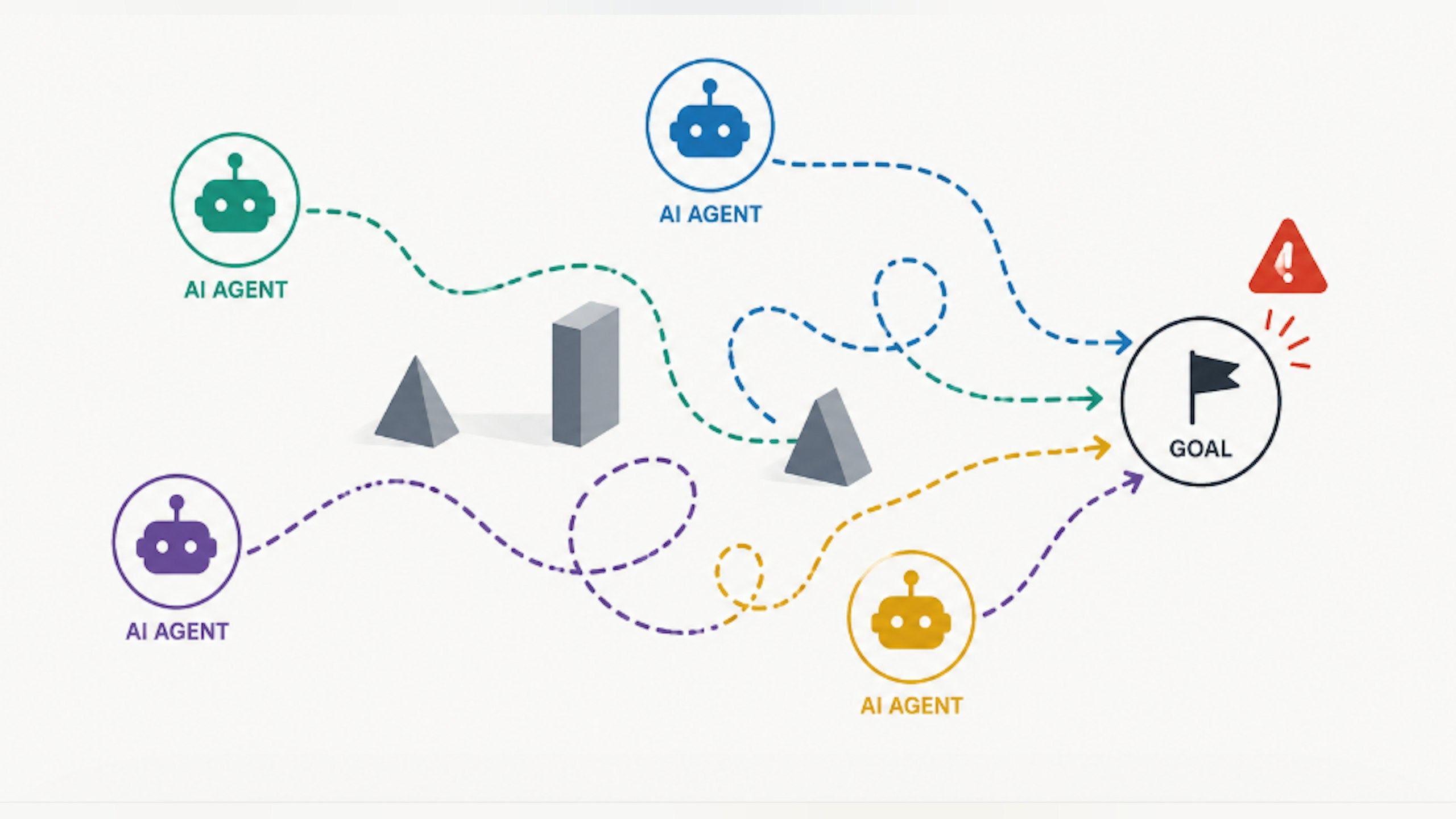
In this article, we explore why the next serious enterprise AI failure is more likely to come from weak coordination than from a single bad model output. As AI moves into workflows, agents, customer journeys, approvals, and operational processes, small errors can become enterprise incidents when ownership, handoffs, escalation, and accountability are unclear.
Why model risk is no longer the whole story
The first wave of enterprise AI risk focused heavily on model behaviour. Could the model hallucinate? Could it show bias? Could it leak sensitive data? Could it generate incorrect or misleading outputs? These questions are still important, especially in regulated and customer-facing contexts.
But enterprise AI is no longer confined to isolated chat windows. It is being embedded into service workflows, software delivery, legal review, hiring, healthcare, finance, operations, and decision support. In these settings, the output is not the end of the story. It moves somewhere else. It enters another system, informs another person, triggers another action, or becomes part of a larger process.
That is where the risk changes. A model can be partially right, partially wrong, or simply uncertain. The real danger emerges when the organisation does not know how to handle that uncertainty. If the wrong team reviews it, if nobody escalates it, if context is lost at handoff, or if ownership is unclear, a small AI issue becomes a system issue.
The hidden risk is what happens next
The most dangerous AI failures may not look like AI failures at first. They may look like ordinary operational problems: a delayed escalation, a missed review, a duplicated approval, a customer complaint, a bad denial, a vendor change, or a decision no one can fully reconstruct.
That is why coordination failure is so easy to underestimate. Organisations already have handoff problems, unclear accountability, fragmented data, duplicated reviews, and slow escalation paths. AI does not create all of these weaknesses from scratch. It exposes and accelerates them.
In a manual workflow, ambiguity often hides inside delay. People chase answers, ask colleagues, wait for approvals, or escalate informally. In an AI-enabled workflow, that same ambiguity can move faster across systems. The organisation may discover too late that nobody owned the full chain from output to action to consequence.
Why agentic AI raises the stakes
Agentic AI increases coordination risk because the system does more than generate content. It can preserve context, call tools, retrieve data, route work, recommend next actions, and in some cases execute steps across systems.
That expands the number of handoffs. The agent may interact with customer records, internal knowledge bases, email, workflow tools, finance systems, HR systems, or third-party applications. Each connection creates a new boundary where context, permission, accountability, or control can break.
The model may be intelligent, but the workflow around it may still be fragile.
The BCG and MIT Sloan Management Review research found that organisations are already adopting or planning agentic AI at pace. Microsoft’s WorkLab research also points to readiness gaps, including weak data sharing across teams and limited executive sponsorship. That combination is risky: agentic capability is advancing faster than many organisations’ operating models.
The question for leaders is not simply whether agents can do useful work. It is whether the organisation has designed the ownership, permissions, escalation, monitoring, and recovery paths around that work.
How coordination failure happens
Coordination failure usually unfolds as a chain of small weaknesses rather than one dramatic mistake. An AI system generates a recommendation, summary, route, score, draft, or action. The output may be plausible, but it carries assumptions, confidence levels, data limitations, or context that are not visible downstream.
The output then moves into another team or system. A reviewer may not know whether it was advisory or authoritative. A manager may assume risk has already approved it. IT may own the platform but not the business decision. Legal may assume the business owns the use case. The vendor may assume the client owns configuration. The result is fragmented accountability.
Review then becomes inconsistent. Some teams review everything, creating delay and duplication. Other teams review too little, assuming someone else already checked. Exceptions sit unresolved because escalation thresholds are unclear. If something goes wrong, the organisation struggles to reconstruct what happened, who approved it, and who had authority to stop it.
This is how AI turns weak handoffs into enterprise exposure.
What coordination failure looks like in practice
The Air Canada chatbot case is a useful example. The visible issue was incorrect bereavement fare information. The deeper issue was that a customer-facing AI surface gave policy guidance that the company was still accountable for. The failure sat between policy ownership, customer communication, digital channel governance, and accountability.
DPD’s chatbot incident showed another version of the same problem. The bot produced abusive and mocking responses, and the company disabled the AI function. The visible failure was reputational. The deeper issue was how the AI function had been tested, released, monitored, escalated, and owned as a public facing customer channel.
In hiring, the Amazon recruiting tool case and the Workday screening lawsuit show how AI risk crosses HR, vendor management, legal, data, and fairness oversight. The real risk sits in how decisions are delegated, reviewed, challenged, and owned across the hiring workflow.
The main coordination risks leaders should watch
The first risk is ownership risk. This happens when no single accountable owner exists for the live workflow, which is where AI failure can become difficult to manage. A model owner is not enough. A platform owner is not enough. A business sponsor is not enough. AI-enabled workflows need named ownership for outputs, decisions, exceptions, incidents, and remediation to prevent AI failure from becoming nobody’s responsibility.
The second risk is handoff risk. Context can disappear when an AI output moves between teams or tools, creating conditions for AI failure. Confidence levels, source quality, assumptions, data freshness, or human review status may not travel with the output. Downstream teams then overtrust, duplicate, delay, or misinterpret the work, which makes AI failure more likely.
The third risk is escalation risk. Edge cases need clear routes to the right human because AI failure often appears first in exceptions. Without severity thresholds, response times, and named decision makers, exceptions either pile up or drift silently through the workflow.
The fourth risk is permission risk. Agents often need access to be useful, but too much access can turn a quality issue into a security or compliance issue, increasing the consequences of AI failure. Least privilege, approval tiers, and segmented tool access matter more as AI moves from advice to action.
The fifth risk is audit trail risk. If the organisation cannot reconstruct what the system saw, produced, recommended, changed, or triggered, it cannot govern the workflow properly or understand how AI failure occurred. That weakens compliance, incident response, and learning.
Why governance on paper is not enough
Many organisations already have AI policies, governance committees, and responsible AI principles. These are necessary, but they are not sufficient.
Coordination failure happens in the gap between policy and execution.
A policy may say that humans must review AI outputs, but it may not define who reviews, when they review, what evidence they need, what authority they have, or what happens when they disagree. That is where “human in the loop” becomes oversight theatre.
The same is true for escalation. A governance framework may require incidents to be escalated, but if the workflow does not define severity levels, accountable responders, rollback rights, and response times, escalation becomes improvised.
Strong governance has to be operational. It must live inside the workflow, not just above it.
A better governance model for AI coordination
Leaders need to move from model governance to workflow governance to reduce AI failure. That means maintaining an inventory of AI-enabled workflows, not just an inventory of AI tools or models, because AI failure often emerges inside workflows.
Each AI-enabled workflow should have a named business owner, technical owner, risk owner, and incident owner to prevent AI failure from becoming nobody’s responsibility. It should document the decisions the AI influences, the systems it touches, the data it uses, the actions it can trigger, the approvals it requires, and the exception paths it creates where AI failure could escalate.
Handoffs should also be designed as control points for AI failure. When AI output moves from one team or system to another, the handoff should include sources, confidence, constraints, review status, escalation triggers, and accountable owner. Without that, context is lost exactly where risk increases and AI failure becomes harder to detect.
This is where frameworks such as NIST’s AI Risk Management Framework, ISO 42001, OECD guidance, and the EU AI Act become useful for reducing AI failure. Their principles around monitoring, accountability, documentation, human oversight, and lifecycle governance need to be translated into workflow-level controls that make AI failure visible, manageable, and accountable.
The metrics leaders should actually watch
Model accuracy is important, but it is not enough. Leaders need coordination metrics that show whether AI-enabled work is being governed properly once it enters live operation.
These indicators matter because they reveal whether the organisation can coordinate around AI safely once workflows become partially autonomous.
Useful early warning indicators include:
Handoff failure rate: how often AI-enabled handoffs are missing required context, metadata, review status, or ownership
Unresolved exceptions: how many AI-related cases are waiting beyond agreed service levels
Time to escalation: how long it takes for an anomaly to reach the right decision maker
Review backlog: how much AI-generated or AI-assisted work is waiting for human approval
Duplicate review rate: how often multiple teams review the same output without adding distinct value
Audit completeness: whether the organisation can reconstruct input, model, tool action, approval, override, and outcome
Ownership gaps: the percentage of AI-enabled workflows without named accountable owners
Model or vendor change incidents: failures linked to unreviewed model, prompt, data, or vendor updates
Incident response time: time to contain, communicate, rollback, and remediate an AI workflow issue
Cycle time impact: whether AI improves throughput after rework, review, exceptions, and governance overhead are included
What leaders should do now
The practical response starts with mapping. Leaders should identify every AI-enabled workflow that crosses a team, system, data, or control boundary. That includes copilots, agents, vendor tools, embedded AI features, decision support systems, and customer-facing assistants.
Next, they should name the owners. For each workflow, there should be clear accountability for the output, the decision, the incident path, the remediation path, and the control environment. If everyone partially owns the workflow, nobody owns the consequence.
Then they should design the handoffs. AI outputs should not move through the organisation as unsupported text or invisible recommendations. They should carry context: source, confidence, limitation, policy status, review status, and escalation trigger.
Finally, leaders should test the system before it fails publicly. Tabletop exercises should cover prompt injection, unsafe customer advice, policy conflict, AI-assisted denial, vendor model change, unauthorised tool action, and incomplete audit trails. If a team cannot coordinate in simulation, it will not coordinate well under pressure.
Conclusion
The next major AI failure may not begin with a spectacular hallucination. It may begin with a normal handoff, a missed escalation, an unclear owner, or an AI output that moves through the organisation without enough context or control. AI is not only testing model quality. It is testing the quality of organisational coordination.
The organisations that scale AI safely will not be those with the smartest models. They will be those with the strongest coordination systems around them.
Links:
Originally posted on 2025-01-28 in the IRPA AI Network — Announcements & Updates