There has been a lot of debate on digital transformation at the organizational level across the globe. But that conversation has often been at the expense of a healthier macro-economic country or industry-level debate. Many countries and organizations now view industrial digital transformation as the new driver of economic growth with industrial nations like China, the US, Germany, and Japan already pressing ahead with top-level national strategies to accelerate industrial digital transformation. Industrial nations are focusing on digitalizing, connecting, and enhancing industrial manufacturing to drive economic development and create national economic advantage.
They are doing this to strengthen the core competitiveness of their nation's industries in order to build competitive advantages in areas other governments have yet to consider. Innovative organizations in Europe, Asia, and the US are investing in industrial digital technologies to create smart factories with low-latency 5G advanced wireless technology at their core. Exquisite Automotive, was the first real-life application of 5G for the core links of industrial control and the first technical verification of all-wireless flexible production employing 5G-Advanced URLLC.
The Spread and Broad Adoption of Industrial Digital Technology
Over the past 50 years, organizations have traditionally used lean, automation, labor cost arbitrage, bespoke production facilities, and more to lower costs and improve manufacturing efficiency. COVID-19 forced organizations to rethink how and where they delivered value. Digital operation capabilities have become a must for manufacturing organizations. Recent developments in digital technologies such as Artificial Intelligence, digital twins, big data, cloud computing, robotics, and machine vision have created more possibilities for industry. As a result, organizations are adopting digital technologies more broadly than ever, resulting in new opportunities for smart manufacturing.
Mass production has reached specific bottlenecks as consumers' demand for personalized products has increased, and as a result, flexible manufacturing has gained more and more traction. Flexible manufacturing refers to the ability to produce customized products at a small scale flexibly and respond to supply chain changes agilely and accurately. Flexible and automated systems can support faster turnover and higher levels of product customization.
In addition, an increasing number of industrial scenarios, especially core production scenarios, require more advanced wireless network capabilities than, for example, 5G can deliver today. The introduction of 5G-Advanced is ushering in a new wave of wireless technology that will enhance the three existing pillars of 5G, including IoT, eMBB, and URLLC by improving its speed, coverage, mobility, and power efficiency.
The manufacturing industry already agrees that 5G-Advanced wireless connectivity will be a key milestone in the evolution of 5G. 5G-Advanced has already demonstrated its technological capacity to connect individuals, homes, enterprises, things, and vehicles.
For example, Huawei and China Unicom built the world's first wireless flexible production line that applies 5G-Advanced's ultra-reliable low-latency communications (URLLC) capabilities in a core control network layer at Exquisite Automotive Systems Co., Ltd. body shop in Hebei Province, China.
This is the first ultra-reliable (4 ms five-9s availability) and low-latency flexible production line with 5G-A (5G-A has a latency of 4 ms and 5G is around 20 ms). With this platform, Exquisite Automotive is able to achieve end-to-end quality traceability management shorten the construction cycle by 1/3, and reduce the cost of construction and maintenance by 1/4.
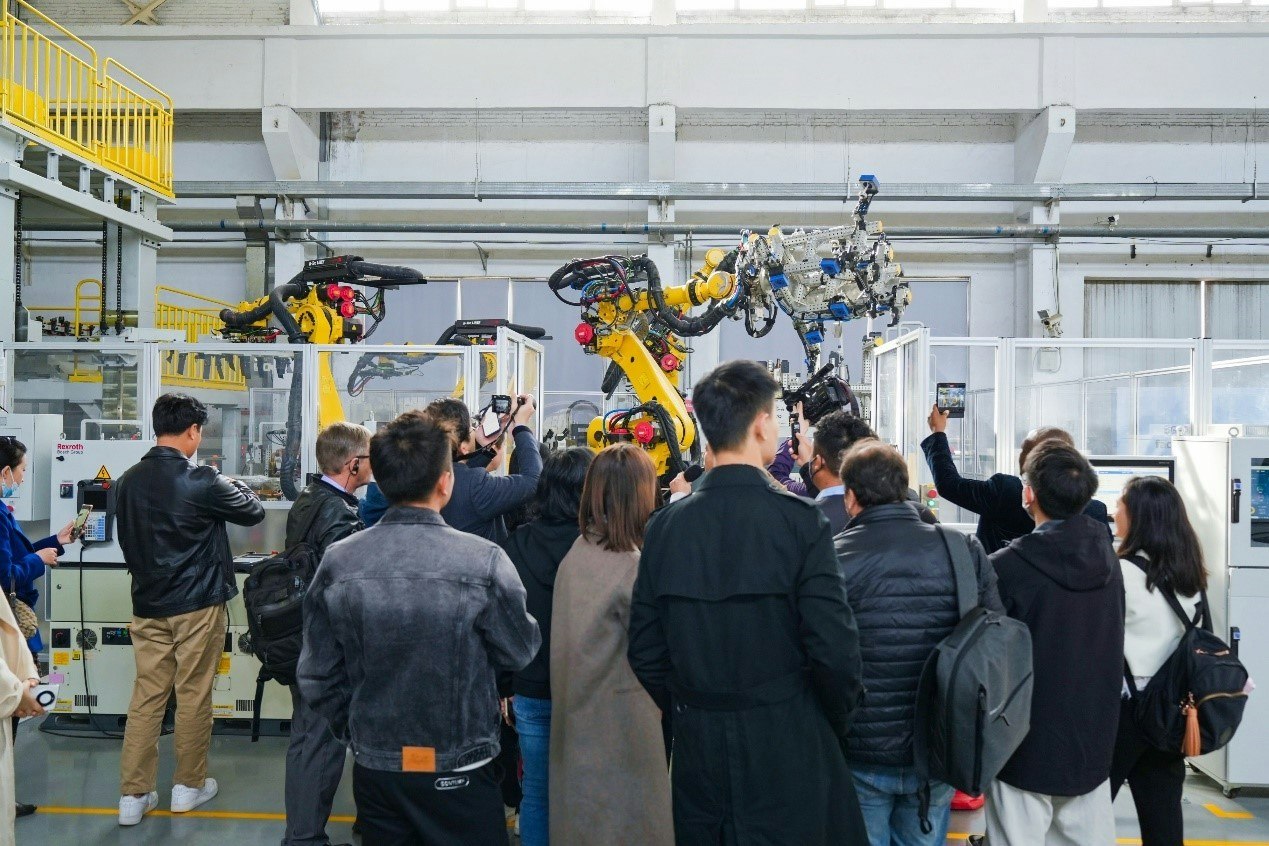
Observers watch industrial robots working based on instructions wirelessly transmitted at high speeds via 5G-Advanced indoor base stations
Traditional industrial control relies on wired networks to realize the serial connection and control of terminal equipment. However, after a certain period of operations, wire abrasions in mobile application scenarios, such as robot arms, slide units, and swiveling tables, often result in production interruptions, causing an average of about 60 hours of downtime a year. Wireless industrial networks can completely eliminate the constraints of wires.
Compared to wired networks, the 5G-Advanced solution facilitates easier network deployment and can better support flexible manufacturing. 5G-Advanced networks also boost efficiency by integrating multiple functions, such as data collection (IT) and industrial control (OT) functions that are provided by two separate private lines in wired networks.
5G-Advanced networks provide ultra-high reliability and ultra-low latency, making them the perfect choice for high-end core manufacturing processes that require high response speeds. Compared to 5G 1Gbps downlink, 5- GA’s is now improved to 10Gbps, and its latency has been shortened to 4 ms from 10 ms and its reliability has improved from three or four 9s to five or six 9s.
Why are world-leading international carriers engaged in 5G-Advanced innovation?
Fully connected 5G factories can promote the construction of digital twin factories, enabling wireless, flexible, and collaborative production. Digital technologies such as 5G-Advanced can now deliver lower latency, higher speeds, precision, and higher density than 5G, allowing for more diverse industrial IoT applications and making industrial production more digital, wireless, collaborative, flexible, and intelligent.
Because 5G-Advanced delivers lower latency and higher speeds, precision, and density than 5G, 5G-Advanced has higher connection density, supporting more than 1,000 connections per 5,000 m2. This allows for more diverse industrial IoT applications. In addition, its centimetre-level positioning and sensing precision can improve production safety sensing and vehicle scheduling. To put it simply, 5G-Advanced connectivity makes production more digital, flexible, and intelligent.
Who is using 5G-Advanced to make a tangible impact?
Today, the world's leading carriers are already engaged in 5G-advanced innovation. For example, over 20 carriers in the UAE, China, Kuwait, Saudi Arabia, Germany, Türkiye, France, and more, are actively working with key 5G-Advanced technologies. 5G-Advanced has demonstrated its technological capacity to provide responsive and reliable connectivity to individuals, homes, enterprises, IoT devices, and vehicles.
Exquisite Automotive's implementation of 5G-Advanced in its body shop, was the first application of 5G-Advanced in a core, industrial production line. Exquisite Automotive's 65,000-m2 facility produces hybrid vehicles and has more than 300 robots and 120 workstations that can produce a complete vehicle in 80 seconds, thanks to its high degree of automation. This proves that 5G-Advanced can support the industrial control networks needed by high-end welding and assembly production lines, such as those of the automobile industry, and marked a major step toward bringing 5G to the industrial internet.
More connectivity and innovation without the need for cables
Digital technologies have created more possibilities for manufacturers to deliver their goods faster, more affordably, economically, and digitally than ever before. They are helping traditional industries become entirely wireless, digital, connected, and intelligent whilst greatly improving business productivity and its working environment.
Faster, more reliable communication underpins the automotive industry's ambitions. As industrial production facilities ‘go more digital’ organizations are generating more data than can be distributed effectively and efficiently over existing 4G and 5G networks. Advanced-5G is a significant leap forward from its 4G and 5G predecessors and helps the industry keep one step ahead of this growing demand.
Advanced-5G, the latest milestone in the 5G era, has captured the attention of many stakeholders, from automakers and Tier 1s to chipset and wireless module suppliers, because of its ultra-fast data transfer speeds, low latency, lower power usage, and massive increase in network capacity. As such, 5G-Advanced, like industrial Ethernet, will become a key technology for industrial control if governments promote the uptake of 5G and 5G-Advanced at a faster rate.
The Exquisite Automotive 5G-Advanced wireless project, which brought together China Unicom, Huawei, and others, sets an example of how joint innovation between integrators, network suppliers, and ecosystem integrators can work in this field. In the future, expect to see more 5G infrastructure built to support the growing number of high-speed 5G-enabled devices and smart connectivity solutions will launch in coming years e.g., smart, entirely wireless production facilities, smart transportation, and smart city applications. Also expect to see more joint ventures and innovation in this space as businesses better understand 5G-Advanced application scenarios and technical principles in the production lines.
Links:
Originally posted on 2023-11-16 in the IRPA AI Network — Intelligent Automation